
POS systems for coffee shops and cafes
A coffee shop is the smallest ticket in food service and the deepest modifier tree, and both facts point at the same conclusion: the POS decisions that are minor for a steakhouse are existential here. The per swipe fee is the biggest one, and almost nobody selling you a system will bring it up.
 Judd Alsup and the Equip Payment Solutions team, who install and support restaurant POS systems nationwide and sell Shift4 Dine and Clover.
Updated August 9, 2026. Sources and dates cited on every figure.
The short answer
For a coffee shop, where a 15 cent fee on a $4.25 latte is 3.5% before the rate starts:
- Square the honest default below roughly $25,000 a month; published rates, familiar hardware, no contract.
- Shift4 Dine wins as volume climbs; interchange plus with a 10 cent fixed fee, $29.99 a terminal published. We install this.
- Genius a published dime fee but a 3 year term, mandatory 4% cash discounting and a $250,000 volume floor.
- Clover good counter hardware, reseller set economics.
- Toast more system than an espresso bar needs; fits cafes with real food programs.
The rest of this page is the case for each line, with sources.
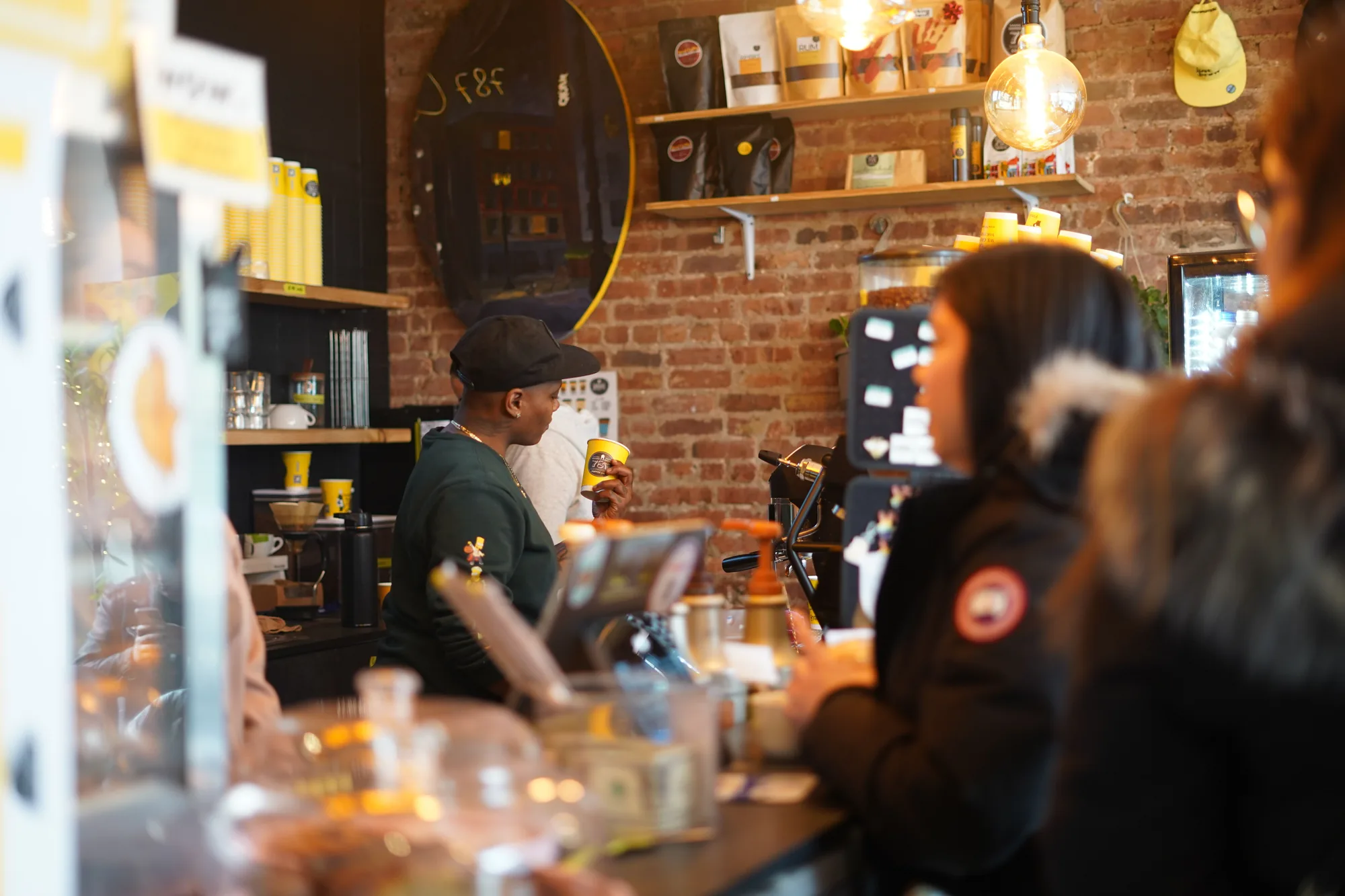
What this room needs from a POS
Modifiers with structure, not free text
Oat milk, half caff, extra shot, lavender, 140 degrees, for here. A latte is a build sheet. The system has to price each modifier correctly, route it to the bar readably, and keep the most common builds to two taps. Free text notes are where drink quality goes to die.
Speed at the register and at the handoff
The line moves at the speed of the slowest of three stations: order, pay, hand off. Payment is the one the POS controls outright, and tap to pay with no signature screen theater is the difference between a line that moves and one that walks out the door.
Offline mode that actually takes payments
The morning rush does not pause for your internet provider. Ask specifically what happens to card payments when the connection drops: queued and captured later, declined outright, or cash only. Get the answer in writing, because vendors describe offline mode generously.
Loyalty that lives in the payment, not in an app
Coffee is the most habitual purchase in food service. Loyalty tied to the card tap, no phone number recital, no separate app, is the version that actually gets used at rush.
Counts for milk, cups and pastry, not full inventory
A cafe does not need recipe level inventory. It needs to know it is about to run out of oat milk on a Saturday. Par alerts on twenty items beat a full inventory module nobody updates.
The 15 cent problem, stated plainly
Here is the arithmetic every coffee shop owner should see once. On a $4.25 latte, a 15 cent fixed fee is 3.5% of the sale before any percentage rate applies. Square's published free plan rate of 2.6% plus 15 cents lands at an effective 6.13% on that latte. The percentage on the sign is not the rate you pay; at coffee ticket sizes, the fixed fee is most of the story.
Now multiply. A shop doing $28,000 a month at a $5.50 average ticket runs about 5,100 card transactions. The fixed fees alone: $765 a month at 15 cents, $510 at 10 cents. That $255 monthly difference, $3,060 a year, is invisible on every rate sheet because rate sheets lead with the percentage. This single number is why we built the fee calculator with an average ticket slider, and why dragging it below $6 reorders the entire board.
The other cafe specific trap is the free software tier. Free plans are financed by the processing rate, and a cafe is exactly the volume profile where that financing costs most. Kitchen display and kiosk hardware are also commonly excluded from free tiers, Square's among them, which matters the day you add food.
The systems, judged for this room
Square is the default for a reason, at the right volume
Fast, familiar to staff, honest published pricing, no contract. Below roughly $25,000 a month it is very hard to argue against. Above that, its own numbers say the paid plan beats the free one, and the 15 cent fee keeps compounding either way.
Genius's published 10 cent fee is interesting and the strings are not
2.6% plus 10 cents published beats Square per swipe at cafe tickets. The offer fine print requires a three year term, 4% cash discounting and $250,000 annual volume. Most single cafes should read that last number and move on.
Shift4 Dine wins when volume justifies a real quote
Interchange plus a stated markup and a 10 cent fixed fee, $29.99 a terminal. Interchange on small debit heavy tickets is often lower than any flat rate admits, which is precisely when interchange plus shines. We install this one. Push us on it.
Toast is more system than most cafes need
Toast's strength is kitchen operations. A cafe with a real food program and multiple registers can grow into it; an espresso bar with a pastry case is paying, in reported rate, for capability it will not use.
Clover works when the reseller quote is honest
The counter hardware is genuinely good for cafes. Whether the deal is good depends entirely on the quote, because the reseller sets the rate. Effective rate in writing, then compare.
The economics: your average ticket is the whole ballgame
Two cafes with identical monthly card volume can pay hundreds of dollars a month apart purely on ticket size, because transaction count, not volume, drives the fixed fee bill. Before comparing vendors, know three numbers: monthly card volume, average ticket, and transaction count. They are all on your statement, and they are all the calculator needs.
If your ticket is under $7, weight the fixed fee over the percentage every time, consider whether a modest price on the paid tier buys down the rate, and treat any quote that will not state your effective rate as a no. A cafe margin does not have room for a 6% effective rate on espresso.
What the major systems charge
| System | Software | Card present rate | Contract | The part they lead with least |
|---|---|---|---|---|
| Toast | $0 to $69per terminal, reported | 2.49% to 3.69%+ 15c, reported | 1 to 3 years | The rate climbs with add-ons. Online ordering and delivery move Starter Kit from 3.09% to 3.39%, and gift cards and loyalty take it to 3.69%. That higher rate then applies to every order, not just the online ones. Processing is mandatory and hardware is locked to Toast. |
| Square | $0 / $49 / $149per location, published | 2.6% / 2.5% / 2.4%+ 15c, published | None | The free plan carries the highest rate. Above roughly $25,000 a month in card volume it costs more than the paid one. Kitchen display and kiosk are excluded from free. |
| Clover | $89.95 to $129.85plus $849 to $4,447 hardware, reported | 2.3% + 10crestaurant plans, reported. The reseller sets your final rate | 36 months | Your rate depends entirely on who sold it to you, and identical hardware carries very different pricing from different sellers. Read who owns the equipment before signing. |
| Geniuswas Vital | $0 / $42 / $129published | 2.6% + 10cpublished | 3 years | Their own footnote requires a three year term, 4% cash discounting and $250,000 a year in volume, and mentions an early termination fee. Their pricing page asks about termination fees and then does not answer it. |
| Shift4 DineWe install this | $29.99per terminal, published | Interchange plusmarkup shown in writing | 36 months | What a rep will not lead with: there is a $250 annual program fee per device, an annual regulatory fee, and a yearly escalator on a 36 month agreement. We put all of it in the quote. What you get is a rate where the processor's margin is visible instead of blended into one number. |
| Lightspeed | $69 / $189 / $399published | 2.4% to 2.6% + 10creported, sources disagree | Month to month or annual | A reported $400 a month penalty applies for using a payment processor other than Lightspeed Payments, which makes their processing effectively mandatory. The published software page never states whether prices are per terminal or per location. |
| TouchBistro | $69 or $119published | Not publishedquote based, partner processors | Sources conflict | One reviewer reports month to month, another reports multi year auto renewing contracts that cannot be terminated early. The add-on stack is where the bill grows: reported $25 to $229 a month per module, and a reported $200 setup fee. |
| SpotOn | $0 or $55per station, published | 2.79% + 20c or 2.45% + 15cpublished | 2 years or monthly | The most published rate card in the category after Square. The fine print: a reported $995 conversion fee plus doubled software cost if you switch processors, and cancelling All-In inside a year claws back the hardware discount. |
Square, Genius, SpotOn, Shift4 and Lightspeed software figures are published by those vendors and were read on their own pages on 8 August 2026. Toast, Clover and TouchBistro figures are reported by Merchant Maverick, Expert Market, POSUSA, NerdWallet, business.com and KORONA POS, cross checked against at least two independent sources where possible and labelled where sources disagree. Software units differ: Square prices per location, Toast and Shift4 per terminal, Clover per device, SpotOn per station. Rates change without notice. General guidance, not legal, tax or accounting advice.
Questions owners ask
What is the best POS for a coffee shop?
At modest volume, Square, and we say that while selling against it. As volume climbs past roughly $25,000 a month in cards, the free plan stops being free in effect, and interchange plus quotes with a 10 cent fixed fee start winning. The crossover is visible in the calculator at your own numbers.
Why is my effective rate so much higher than the advertised rate?
Because the advertised rate ignores the fixed per transaction fee, and at coffee ticket sizes that fee is enormous in percentage terms. Fifteen cents on a $4 sale is 3.75% on its own. Effective rate, total fees divided by total volume, is the only number that tells the truth at a cafe.
Do I need offline mode?
If you are in a location where the internet ever drops during rush, yes, and the detail matters: some systems queue card payments offline and capture them later, others stop taking cards entirely. The morning you find out which one you bought should not be a Saturday.
Should the tip screen ask at the register or the handoff?
At the register, on the payment device, with sane defaults. Percentage prompts calibrated to a $5 ticket read as dollars, not percentages: most owners see tips rise when the options are 25, 50 and 75 cents rather than 15, 20 and 25 percent on a small sale.
Have your own numbers checked
Send last month's statement. We read it with you, free, and tell you straight whether we are the ones to fix it.
Send your numbers
About a minute. It goes straight to the Equip team.
It reaches the Equip team. A person calls you back, and if we do not have a crew near you, the team routes it to whoever serves you best. We never ask for card or bank details on this site.